Company Formation in Qatar: Requirements and Costs (2026)
Index
- Summary
- What Are the Requirements for Company Formation in Qatar?
- What Are the Legal Requirements for Company Formation in Qatar?
- What Documents Are Required for Company Formation in Qatar?
- What Are the Capital Requirements for Company Formation in Qatar?
- What Are the Office and Premises Requirements for Company Formation in Qatar?
- What Are the Corporate Tax Obligations for Companies Formed in Qatar?
- What Are the Specific Requirements for Each Company Structure?
- What Are the Realistic Costs for Setting Up a Company in Qatar?
- Do You Need Professional Help to Set Up a Company in Qatar?
- Frequently Asked Questions
Summary
Here is what you need to know about company formation in Qatar requirements :
- Every company needs a correctly classified business activity, an approved trade name, a notarised Article of Association, a Commercial Registration, a Trade Licence, an Establishment ID issued by MOI, and a Tax Card issued by the Ministry of Finance. Getting your Commercial Registration does not mean you are authorised to operate. That comes after.
- A physical office with a valid lease is required for all mainland companies. Virtual addresses are not accepted. Free zone and QFC companies have more flexible options.
- There is no statutory minimum capital for a Mainland LLC. Private joint stock companies require QAR 2,000,000.
- Foreign-owned companies pay 10% corporate income tax on Qatar-source income, registered via the Dhareeba portal. Qatari and GCC-owned companies are generally exempt but must still register and file.
- First-year costs range from QAR 8,000 for a Representative Office to QAR 60,000 for a Free Zone company.
What Are the Requirements for Company Formation in Qatar?
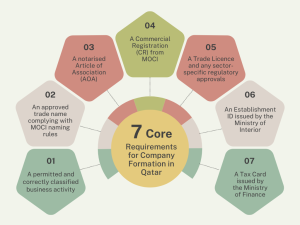
Setting up a company in Qatar involves two categories of requirements: the seven core requirements that apply before your company is registered, and three post-registration requirements that most first-time investors overlook.
The seven core requirements:
- A permitted and correctly classified business activity
- An approved trade name that complies with MOCI’s naming conventions
- A notarised Article of Association (AOA)
- A Commercial Registration (CR) from MOCI
- A Trade Licence and any sector-specific regulatory approvals
- An Establishment ID issued by the Ministry of Interior (MOI)
- A Tax Card issued by the Ministry of Finance
Three post-CR requirements that most guides miss:
- Chamber of Commerce registration. Mandatory for most commercial and trading activities. You cannot fully operate without it.
- Labour and immigration file setup. Required before you can hire any employees or sponsor any work visas.
- Corporate bank account. This is not automatic. Banks carry out their own due diligence independently of MOCI. CR approval does not guarantee bank account approval.
Getting your Commercial Registration is a major milestone. But it is not the finish line. Many first-time investors discover this the hard way after they have already made commitments to clients or staff.
What Are the Legal Requirements for Company Formation in Qatar?
The legal framework for business formation in Qatar is governed primarily by the Commercial Companies Law No. 11 of 2015 and the Foreign Investment Law No. 1 of 2019.
The Foreign Investment Law changed the ownership landscape significantly. It opened up 100% foreign ownership across most sectors. But the eligibility depends on your specific business activity and is not a blanket rule.
Here are the core legal requirements every company must meet:
Business activity classification : Your activity must appear on MOCI’s approved commercial activity list. Choosing the wrong activity, or describing it too broadly, has real legal consequences. Operating outside your licensed scope carries penalties. This is the most important legal decision in the entire process.
Trade name approval : Your company name must be unique and must not mislead the public or imply government affiliation. In 2026, MOCI’s enforcement of naming rules has become stricter. Names that imply regulated sector involvement without authorisation are rejected faster than before.
Article of Association : The AOA is a legal document that must specify your company name, objectives, business activities, capital, share distribution, partners, management structure, profit distribution rules, and dissolution procedures. It must be notarised after approval from the Ministry of Justice.
Sector-specific approvals : Regulated sectors require approvals from the relevant authorities before or alongside your MOCI submission. This includes the Ministry of Public Health, Ministry of Education, Qatar Central Bank, Civil Defence, and others depending on your activity.
2025 to 2026 legal update : Everything must now align perfectly across systems. Your MOCI activity classification, office lease, immigration file, and tax registration must all be consistent. Mismatches that were previously overlooked are now more likely to trigger compliance queries or processing delays.
What Documents Are Required for Company Formation in Qatar?
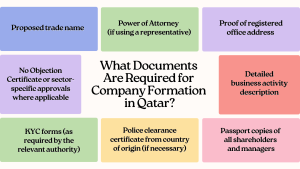
Incomplete or improperly legalised documents are the single biggest cause of delays when forming a company in Qatar. Here is a complete breakdown.
Documents required for all applicants:
- Passport copies of all shareholders and managers
- Proposed trade name (three alternatives recommended)
- Power of Attorney if using a representative
- Proof of registered office address (valid lease agreement)
- Detailed business activity description
- No Objection Certificate or sector-specific approvals where applicable
- KYC forms as required by the relevant authority
- Police clearance certificate from country of origin, if necessary
Additional documents for foreign corporate shareholders:
- Certificate of Registration of the foreign company
- Certificate of Good Standing
- AOA and Articles of Association of the foreign company
- All corporate documents must be notarised and legalised from the Qatar consulate of Parent Courts as well as the MOFA (Ministry of Foreign Affairs) of the foreign country and Qatar
For foreign corporate shareholders specifically, document legalisation through multiple jurisdictions is the step that most commonly adds weeks to the timeline. Start this process early before anything else.
What Are the Capital Requirements for Company Formation in Qatar?
The most important thing to understand: there is no statutory minimum capital for a Mainland LLC under the Commercial Companies Law. The QAR 200,000 figure widely cited online applies to sole proprietorships and simple partnerships, not LLCs.
Here is the accurate picture by structure:
|
Structure |
Minimum Capital Requirement |
|---|---|
|
Mainland LLC |
No statutory minimum. Declared capital must be stated in AOA |
|
QFC Entity |
No prescribed minimum. It is subject to activity and licensing |
|
Free Zone Company |
No prescribed minimum. It is subject to activity and licensing |
|
Branch Office |
No statutory minimum. However, parent company’s financial standing is required |
|
Representative Office |
No statutory minimum |
|
Single Person Company |
No statutory minimum. It is subject to activity |
|
Private Joint Stock Company |
QAR 2,000,000 |
|
Holding Company |
QAR 10,000,000 |
Even where there is no statutory minimum, you must still declare a capital amount in the AOA. You also need to show evidence of payment or funding capability. Banks may impose their own effective capital expectations based on your business activity and risk profile.
Do not let the absence of a statutory minimum give you false confidence. The practical capital requirements can still be significant.
What Are the Office and Premises Requirements for Company Formation in Qatar?
A physical office is required for all mainland company formation in Qatar. Virtual addresses are not accepted for standard commercial registration under MOCI.
What your lease agreement must include:
- Signatures from both the landlord and the company or its authorised signatory
- Clear identification of the premises, area, and location
- Must be in Arabic or in both Arabic and English
Your premises must also be in a commercially zoned area that is appropriate for your licensed activity. Retail, food, and manufacturing activities have specific zoning, size, and safety requirements.
The most common and costly mistake in this entire process:
Signing a lease before confirming that the premises are suitable for your licensed activity. Not every office address is accepted for every type of business. Many investors discover this after committing to a lease and the delay and cost of resolving it can be significant.
For free zone and QFC entities:
Flexi-desk and virtual office options are available depending on your activity and licence type. However, a registered address linked to the free zone authority is always required. For industrial, logistics, or manufacturing activities within free zones, dedicated physical premises are still necessary.
What Are the Corporate Tax Obligations for Companies Formed in Qatar?
Qatar applies a territorial tax system. This means only income earned from activities within Qatar is taxed. Income your Qatar-registered company earns outside Qatar is generally not subject to Qatari tax.
Who pays corporate tax:
- Foreign-owned or partially foreign-owned companies: 10% on net taxable profits from Qatar-source income
- Wholly Qatari or GCC-owned companies: generally exempt from corporate income tax, but must still register with the General Tax Authority and obtain a tax card
- Oil, gas, and petrochemical companies: 35% minimum rate under Law No. 3 of 2007
- Large multinational groups with revenue exceeding QAR 3 billion: 15% Global Minimum Tax under Law No. 22 of 2024, effective December 2024
Registration and filing obligations for all newly formed companies:
Every company must register with the General Tax Authority via the Dhareeba portal within 30 days of starting operations. This applies regardless of whether your activity is taxable or exempt.
You must obtain a tax card. Without it, you cannot work with government entities, and you risk withholding tax deductions on your invoices.
Other ongoing obligations include:
- Filing your annual tax return and paying any tax due within 4 months of your financial year end
- Maintaining accounting records for 10 years
- Submitting financial statements in Arabic for tax years from January 2020 onward
- Providing audited financial statements if your capital exceeds QAR 200,000, your total income exceeds QAR 500,000, or your head office is located outside Qatar
2025 to 2026 update: The Dhareeba system now cross-checks your company’s tax records against your MOCI registration data. If your declared business activity, office lease, and tax filings do not align, you are now more likely to receive a compliance query or experience a processing delay than you would have been in previous years.
What Are the Specific Requirements for Each Company Structure?
Most of the requirements covered above apply primarily to Mainland LLC formations, which is the most common company structure. What follows are the specific requirements for each other structure, including where the process, authority, and documentation differ significantly from the mainland route.
For a detailed explanation of each structure, read our guide: How to Register a Company in Qatar.
Mainland LLC (WLL)
- Minimum one shareholder, maximum 50
- 100% foreign ownership is available for most activities, but requires activity-specific approval from MOCI or Investment Qatar
- Notarised AOA specifying capital, shareholders, activities, and management structure
- Municipality Trade Licence required after CR is issued
- Chamber of Commerce registration is mandatory
- Regulated activities require sector-specific approvals before or alongside MOCI submission
QFC Entity
- Application submitted directly to the QFC Authority, not MOCI
- A QFC licence application and detailed business plan are required
- Registered address must be within QFC premises. A mainland address is not accepted
- Separate tax regime : 10% on locally sourced profits only, with no withholding tax, no dividend tax, and no capital gains tax
- Annual compliance filing with the QFC Regulatory Authority is required every year
Branch Office
- Must bear the exact same name as the parent company
- Can only conduct the activities specified in the parent company’s incorporation document and nothing beyond those
- Parent company documents including Certificate of Registration, MOA, and board resolution must be notarised and legalised up to the Qatar Embassy in the country of origin
- A local service agent or sponsor is required depending on the activity
- The parent company retains full legal liability for all branch activities and obligations
- The branch must close or renew its licence once the approved contract or project ends
Free Zone Company (QFZA)
- Application submitted to the Qatar Free Zones Authority, not MOCI
- Physical or flexi-desk premises within a designated free zone are required. Either Ras Bufontas near Hamad International Airport or Umm Alhoul
- Cannot sell directly into the Qatar mainland market without registering a separate mainland branch
- 100% foreign ownership is permitted with no Qatari partner required
- Tax exemptions are available depending on activity and licence type
Representative Office
- Can conduct market research, business development, and promotional activities only
- Cannot generate revenue, sign commercial contracts, issue invoices, or conduct any direct trading in Qatar
- Must be supported by and linked to the parent company abroad
- No share capital requirement
- A General Manager who holds Qatar residency must be appointed
- Ministerial approval is required from MOCI’s Investment Promotion Department
- Can be converted into a Mainland LLC if the business later decides to expand its operations in Qatar
Single Person Company
- Available to Qatari nationals and GCC nationals. Foreign investors require a specific exemption under the Foreign Investment Law.
- 100% owned by one individual with full ownership and decision-making authority
- Limited liability protection applies. The owner’s personal assets are generally protected from business liabilities
- All strategic and financial responsibility rests with the sole owner
- Subject to activity-specific capital and licensing requirements
What Are the Realistic Costs for Setting Up a Company in Qatar?
Realistic first-year costs by structure:
|
Structure |
Realistic First-Year Cost (QAR) |
|---|---|
|
Mainland LLC |
QAR 15,000 – 50,000 |
|
QFC Entity |
QAR 15,000 – 40,000 |
|
Branch Office |
QAR 20,000 – 50,000 |
|
Free Zone Company |
QAR 20,000 – 60,000 |
|
Representative Office |
QAR 8,000 – 20,000 |
Costs for regulated activities, complex ownership structures, or setups requiring extensive document legalisation may exceed these ranges. Qatari and GCC-owned businesses setting up a Single Person Company or partnership structure should contact our team directly for a tailored cost assessment.
Where costs go higher than expected:
Most businesses budget for government registration fees and nothing else. The costs that catch people off guard are:
- Office rent and serviced office packages
- Document legalisation, attestation, and certified translation
- Sector-specific regulatory approval fees
- Banking compliance documentation
- Immigration and Establishment Card costs
- Professional service fees
Government fees are rarely the largest cost in the first year. Premises and compliance costs almost always are.
The cost of getting it wrong:
If your company formation is done incorrectly, fixing it is neither quick nor cheap. Minor amendments can cost a few thousand QAR. Restructuring an incorrectly formed company can cost between QAR 10,000 and QAR 50,000 or more, and can take several weeks to several months to resolve.
The cost of getting proper guidance upfront is almost always lower than the cost of fixing mistakes later.
Do You Need Professional Help to Set Up a Company in Qatar?
A simple, low-risk setup with straightforward documentation can sometimes be managed independently. That is the honest answer.
But here is the reality most people underestimate.
Forming a company in Qatar is not just about submitting documents. It is about simultaneously aligning your activity classification, documents, capital, premises, tax registration, and sector-specific approvals. A mistake in any one of these areas can create a chain of sequential corrections that can push your entire timeline back by weeks or months.
Since 2012, Professional Services (PBG) has completed over 4,000 company formation projects in Qatar across mainland, QFC, branch, free zone, and representative office structures, with expertise across 25 different industries.
Before a single document is submitted, our team at Professional Services (PBG) carries out a full pre-application assessment to review everything about your business, identify risks beforehand and carry out all the procedures with zero hassle.
If you are ready to get started or simply want to understand your options before committing to anything, book a free consultation with our team or give us a call at +974 30913211.
Frequently Asked Questions
What is the minimum capital requirement for company formation in Qatar?
For a Mainland LLC, there is no statutory minimum capital under Qatar’s Commercial Companies Law. You must declare a capital amount in the MOA and may need to show evidence of funding capability. Sole proprietorships and simple partnerships require QAR 200,000. Private joint stock companies require QAR 2,000,000. The figure varies significantly by structure.
Can a foreigner own 100% of a company in Qatar?
Yes, for most business activities. The Foreign Investment Law No. 1 of 2019 opened up 100% foreign ownership across most sectors including professional services, consulting, technology, trading, manufacturing, healthcare, and education. Activities that remain restricted include commercial agencies, certain banking and insurance activities, and specific financial services.
What documents do foreign shareholders need for company formation in Qatar?
Foreign individual shareholders need attested passport copies, a police clearance certificate from their country of origin, and a bank reference letter. Foreign corporate shareholders additionally need the parent company’s Certificate of Registration, Certificate of Good Standing, MOA and AOA, and a notarised board resolution legalised up to the Qatar Embassy in the country of origin. All documents must be certified translated into Arabic.
What are the restricted sectors for foreign ownership in Qatar?
Foreign investors cannot hold 100% ownership in commercial agencies, certain banking and insurance activities, and specific financial services without special approval or local participation. Most other sectors including professional services, consulting, technology, trading, healthcare, education, manufacturing, and tourism are open to full foreign ownership subject to MOCI approval and activity-specific licensing requirements.
What is the corporate tax rate for foreign companies in Qatar?
The standard corporate income tax rate is 10% on net taxable profits from Qatar-source income for foreign-owned or partially foreign-owned companies. Oil, gas, and petrochemical companies pay a minimum rate of 35%. Large multinational groups with revenue exceeding QAR 3 billion are subject to a 15% Global Minimum Tax effective from December 2024. Wholly Qatari or GCC-owned companies are generally exempt from corporate income tax.
What happens if my company formation is done incorrectly in Qatar?
The cost and time required to fix an incorrectly formed company depends on the severity of the issue. Minor amendments may cost a few thousand QAR. Restructuring a company with the wrong activity classification, incorrect ownership structure, or unsuitable premises can cost between QAR 10,000 and QAR 50,000 or more, and can take several weeks to several months to resolve.
Do I need a physical office for company formation in Qatar?
Yes, for all mainland companies in Qatar. A valid lease agreement for a physical office must be submitted as part of your Commercial Registration application. Virtual addresses are not accepted for standard mainland registration. Free zone and QFC entities may use flexi-desk or virtual office arrangements depending on their activity and licence type, but a registered address linked to the relevant authority is always required.